Sunday, March 25, 2012

Psychodrama gets (+) mention in Psychotherapy Networker


The current issue of Psychotherapy Networker mentions psychodrama  for the good. In the current issue -- which celebrates the 30th year of the fabulous magazine -- a reprised article from 2007 looks at  "The Most Discredited Therapies."

The article contrasts therapies that have been considered discredited -- like prefrontal lobotomies, reparative therapies for homosexuality and others -- with therapies that are  deemed credible, like EMDR, humor therapy for depression, etc.
 
And about psychodrama: "Several older methods, including J.L.Moreno's psychodrama and Wilfred Bion's psychoanalytically oriented group analysis, also noted respectable ratings."  

In the article, psychologist John Norcross stresses that a discredited ranking of any treatment should primarily be construed as a call for more research, not as a condemnation, that experts "can and have been wrong," and that therapists shouldn't be afraid to be innovative and trust their intuition. Nevertheless, he says, the study has generated considerable controversy, including protests from many psychotherapists who pointed out that they themselves have successfully used some of the most "discredited" treatments like the Luscher Color Test for personality assessment.

Saturday, March 24, 2012

Psychodrama bibliography is available to all

Are you writing a research paper about psychodrama, group psychotherapy, sociometry or other action methods?

Good for you. Our field needs research, documentation and exchange about these methods which are growing worldwide. An invaluable resource is the free online International Bibliography of Psychodrama, which contains more than 6,000 entries including books, journals, papers and the like.

Started by James M. Sacks, it is the fruit of an attempt to compile an exhaustive list of citations of scientific works on psychodrama since its creation by J.L. Moreno. Errors, exclusions and incomplete information that should be corrected should be brought to the attention of Michael Wieser at  michael.wieser@uni-klu.ac.at. You may send copies to Michael Wieser, Department of Psychology, Universitaetsstr 65, 9020 Klagenfurt, Austria, Europe. When submitting references, please use current standard American Psychological Association (2009) format if possible.

Friday, March 23, 2012

Cleveland Institute bringing psychodrama to help Chardon

Jeanne Burger, Ed.D., LPC, LMFT, TEP, a psychodramatist based in Norfolk, Va., will donate her time for a workshop on June 16 sponsored the Cleveland Institute of Psychodrama entitled "To Dream Again," using dream dramas.

Jeanne was trained by Zerka Moreno and her presentation will have a special mention of Zerka Moreno's new memoirs by the same name.

The proceeds will go to Chardon Heals, supporting the Ohio community devastated by the recent shootings at Charon High School that claimed three young lives and left another severely injured.

Subscribe to institute's newsletter to keep apprised of place and other info.

Here is a video that tells more about the tragedy at Chardon High:

Thursday, March 22, 2012

Group psychotherapy association seeks proposals for 2013

The American Group Psychotherapy Association is seeking proposals for its annual conference in 2013 in New Orleans. Submissions are due by April 16, 2012; look for the easy online submission form here

The2013 conference is scheduled at the New Orleans Marriott from Feb. 25-March 2 with the theme of "Overcoming Obstacles: The Power of the Group."

Proposals may be submitted for specific institute sections, workshops and open sessions relevant to the theme. They may come from a research perspective related to a specific theoretical approach, focus on specific populations or an approach used to help them or demonstrate models of therapy that clinicians use to help clients find a way to thrive.

Wednesday, March 21, 2012

Imagery pioneer Jeanne Achterberg dies


One of my personal healing heroines is Jeanne Achterberg – guided imagery pioneer, alternative health advocate and author who died earlier this month on March 7.

Everyone, including psychodramatists and creative arts therapists, uses guided imagery now. Years ago, however, guided imagery was considered on the side of woo-woo and weird.

Through the years, Jeanne advocated for the holistic approach with appreciation for the healing skills of the ancient shamans. Her book Imagery in Healing is acclaimed as a classic in mind-body studies. 

Another book, Woman as Healer, broke ground in surveying the healing activities of women from prehistoric times to the present. Rituals of Healing:  Using Imagery for Health and Wellness (with Barbara Dossey and Leslie Kolkmeier) is a primer on the use of creative therapies for health and medicine. Her most recent book, Lightning at the Gate, told the story of her personal journey, was published in 2001. 

Achterberg's core belief is that we are healed not by medicine but by the bonds we create with each other: care, love, trust, hope, belief, and all the other invisible facets that seem to have lost favor in modern health care:

"My mission has always been to bring humanity into health care, and I have done everything within my grasp that would allow for this to happen. I do believe in modern medicine, but also in traditional and integrative healing. Most of all, I believe in the power of the human spirit and in the web we weave with one another and with everything else on the planet."

Here's an early clip of Jeanne from an interview on Jeffery Mishlolve's Thinking Allowed program:


Tuesday, March 20, 2012

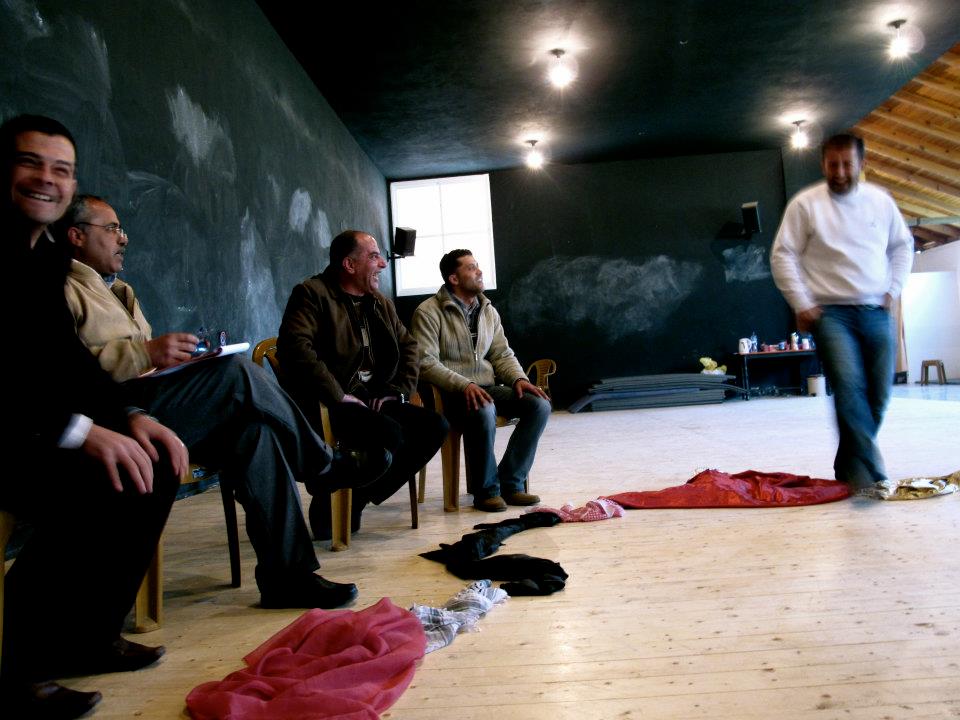
Psychodrama, meet the refugees of Occupied Palestine

Participants in a training session in Jenin on March 18, 2012.
Whenever we find collaboration between cultures in conflict, we can take heart about the possibilities of peace. 

Kate Hudgins, Ph.D., TEP, a psychodramatist based in Charlottesville, Va., will be traveling to the Jenin Refugee Camp in Occupied Palestine in July to work with Ben Rivers, a Playback Theatre practitioner of The Freedom Theatre.

The Freedom Theatre, a theater and cultural center in Jenin Refugee Camp, is developing the only professional venue for theater and multimedia in the north of the West Bank in Occupied Palestine. Since it opened its doors in 2006, the organization continues to grow, develop and expand, enabling the young generation in the area to develop new and important skills to build a better future for themselves and their society.

The pair is putting together the Trauma Response Training Program, which will run for 18 months and teach helping professionals and others how to use psychodrama, particularly the Therapeutic Spiral Model developed by Dr. Hudgins. Participants include 15 social workers, psychologists, counselors and community workers from a variety of government and non-government organizations based in Jenin District. They will learn to use psychodrama and the Therapeutic Spiral Model, which modifies the use of psychodrama to maintain greater safety for survivors of trauma." Attendees will receive an International Certification in Trauma Healing from Therapeutic Spiral International upon completion of the program. 

For more information on the program, contact Ben Rivers; monetary donations for the project, which involves donated time, may be directed to Kate Hudgins.

Monday, March 19, 2012

An affordable way to find items for your sand tray


Are you a sand tray psychotherapist?

Sand tray items can get a little pricy, and rummage sales, yard sales and thrift shops are a good way to find items for your sand tray shelves. I recently found this conglomeration of items at the local Zen center's annual fundraising rummage sale, with the total receipt at just over $5.

Here are lots of other places that I've found items for sand tray for low cost or no cost:

  • Stones, seashells and softly worn glass picked from the beach.
  • Fortune cookie fortunes.
  • Pine cones of various sizes -- watch while walking your neighborhood or at the local park.
  • Junk drawer (variety of marbles, small items, lost Legos, old keys, mismatched playing cards and the like). 
  • Kitchen drawer (small baskets, small scoops, plastic containers, bottle caps, plastic spoons, Popsicle sticks).
  • Jewelry drawer (look for odd earrings, old pendants, etc., such as hearts, stars and other symbolic items). 
  • Sewing kit (old thimbles and darning eggs, buttons).
  • Holiday ornaments and decor that you no longer use (use all or part of item). These might include faux evergreens (take apart to 2-inch lengths to use as bushes), plastic or other kinds of Easter eggs, angel ornaments and Halloween items.
  • Paper umbrellas and plastic picks, saved from tropical drinks, plus chopsticks.
  • Small plastic babies, baskets and other cute party favors from baby and wedding showers.
  • Clearance shelves and racks at department stores, variety stores, rock and gem shops, hobby stores, novelty shops and other shops.
  • "Free" box at yard sales.
  • Small bowl of pennies.
  • Check with children who you know, who outgrow their small toys and other little objects -- or moms who are clearing out!
The money that you save can be spent for small figures that you do not have at online sand tray stores like Toys of the Trade, Child Therapy Toys (which offers a great blog with lots of play therapy and sand tray ideas), Counseling Toys and others, many of which offer clearance sales or periodic discounts and promotions.

Sunday, March 18, 2012

Great rewards at ASGPP's silent auction

Are you attending the 70th annual conference of the American Society of Group Psychotherapy and Psychodrama April 19-23 in Jersey City, N.J.? Be sure to check out the conference's silent auction one of the most fun parts of the conference. Smilebox preview is here. Enjoy!

Saturday, March 17, 2012

With Zerka's memoirs, I remember my own memories

Karen and Zerka Moreno in the 1990s.
It was a cold and snowy day in Lakeville, Conn., in 1991 when I first met Zerka Moreno.

With Zerka's memoirs, titled To Dream Again: A Memoir, just published earlier this month with the assistance of editor Ed Schreiber, I find myself having many memories of my own.

Back in 1991, I was an aspiring psychodramatist and was practicing experiential therapy at the Caron Foundation, a large drug and alcohol treatment center in Wernersville, Pa. I had been reading about Dr. J.L. Moreno, the originator of psychodrama, and became excited when I learned that Zerka, J.L.’s collaborator and widow, was still teaching and demonstrating.  Even better, Zerka was scheduled to present a program  on the psychodrama of dreams, one of my favorite topics, during a weekend program sponsored by the Omega Institute of Holistic Studies.

I enlisted a fellow counselor to join me on the trip to Connecticut. We arrived in the aftermath of a soft snowfall, and I was happily waiting near the buffet line in the lower level of the quaint inn. I was surprised by the entrance of an elder woman who radiated vitality and energy.

“Hello!” I burst out to the woman I knew immediately was Zerka. The happy encounter, however, was quickly squashed by the entrance of Zerka's companion, Merlyn Pitzele, who was vigorously protecting his beloved from celebrity seekers and paparazzi -- as I must have seemed in my outburst. I retreated to the buffet line in great embarrassment, while my colleague comforted me and told me that Zerka had already been talking to Merlyn and was not the least bit offended.

My emotions changed to anticipation when I learned that only a handful of students had signed for the course on this snowy weekend and that each would have the chance to step on stage . The excitement and anticipation turned to awe as I watched Zerka direct drama after drama in a manner that was deep, profound and generally beautiful.

“If you were doing this for 50 years, you too would be seamless,” Zerka told her admiring students. Later, as we clamored for more information, Zerka said sweetly, “If you’d like to know more, you’ll just have to follow me around.”

And so I did. I soon began to make a regular trip from Lancaster, Pa., to the original Moreno stage at  Boughton Place in Highland, N.Y., for Zerka’s monthly trainings with a diverse group of people that came from nearby Ulster County as well throughout New York, New Jersey and New England — and from around the world. 

I've been continually awed and impressed by Zerka’s graciousness and amazing memory as well as her sometimes flamboyant wardrobe, which included interesting necklaces and an equally interesting collection of shoes.
Professionally, I learned to stretch myself to play auxiliaries for others and, like most of the other trainees, competed to get on stage as a protagonist with Zerka. Taking big breath, I finally directed a few dramas in front of Zerka, and she was always kind, yet direct, with my mistakes and my inspirations. When I finally confessed to her about how much her companion scared me with his protective behaviors, she offered me the ultimate in repair scenes -- the opportunity to redo the scene and introduce myself to Zerka in a way that encouraged and supported my spontaneity.

In between, I enjoyed hearing Zerka’s stories about her life with J.L., directives on the proper method of composing a psychodrama and introductions to Playback Theatre, which often offered shows on Friday nights before the  training weekends.

Thursday, March 15, 2012

Update on Trial Lawyers College

Psychodrama is for attorneys too!
In every trial, the attorney is charged with telling the client’s story. Psychodrama helps attorneys learn how to tell their clients' stories  in powerful and dramatic ways, bringing life to the story in the here-and-now. Psychodrama trains attorneys to examine the motivations and forces that compel the witness’ testimony and learn how to walk in the shoes of our clients and to understand the impact of the crime on all the people touched by the tragedy.
Listen to Gerry Spence introduce Josh Karton at the past California Regional of the famous Trial Lawyers College, based at Thunderhead Ranch in Wyoming. The site offers course materials, many written by Spence, and an e-mail newsletter and stories from its alumni.

Wednesday, March 14, 2012

ASGPP conference is a month away. Be sure to register now


Just one  more  month to register for the annual conference of the American Society of Group Psychotherapy and Psychodrama!

This year's conference takes place April 19-23 in Jersey City, N.J., with a full list of workshops, pre-conference and post-conference programs, a chance to mix and mingle with some of the nation's top trainers and a book signing to celebrate our member authors.

Not only is there an exciting and broad program at this year's conference but also at our 70th anniversary you can see how psychodrama has enriched, informed and collaborated with so many areas contemporary arenas of mental health. This evolution is especially noticeable in the pre-conference workshops where psychodrama melds with coaching, eating disorders treatment, family systems and systemic constellation work, Dialectical Behavioral Therapy, Internal Family Systems, body work interpersonal neurobiology and Imago couples work.

Looking at the brochure, we can see that the work of Dr. J.L. Moreno, which debuted on a stage in Vienna, Austria, in 1921 is sustainable and universal and is reaching so many people and places through these many paths. 

A few special events:


The site of this conference should be another incentive to join. The Hyatt Regency is only one station away from the Wall Street station of the PATH train, connected to the famous New York City subway system. The hotel is sited on the scenic Hudson River next to a promenade and many attractive shops and restaurants and boasts breathtaking views of lower Manhattan and Midtown.

Tuesday, March 13, 2012

"Midnight in Paris" a great example of surplus reality

Midnight in Paris has been garnering lots of movie award sparkle, especially the recent win for writer-director Woody Allen as best original screenplay  from the Writer's Guild of America. He also received the Oscar statuette for the screenplay at last month's Academy Awards.

The film stars Owen Wilson as a modern Hollywood writer who stumbles into another dimension of time and has a chance to hang with his literary idols in the 1920s Paris of Hemingway and Fitzgerald and Stein.

This movie is a perfect example for working with surplus reality.  In psychodrama, surplus reality refers to putting into action a wish or a dream. The protagonist has the opportunity to experience this alternate reality to satisfy his or her "act hunger" and learn about self, choices and experience life from this other reality.

Here's a video that gives a taste of the movie: 


Friday, March 9, 2012

Arizona psychodrama in the spotlight


Some psychodrama-loving folks in Arizona have joined together to start the Arizona Psychodrama Institute. This new group -- just born in 2012 -- unites creative individuals from Phoenix, Tempe, Scottsdale, Flagstaff and Tucson, Ariz., under the common mission of teaching psychodrama, sociometry, and group psychotherapy to professionals whose practices would be enhanced by using action methods.

The site is easy to navigate and offers a calendar of events as well as a "store" to order books about psychodrama and experiential psychotherapy as well as the tabella to track training hours.

Monday, February 27, 2012

Psychodrama has powerful results with eating disorders

Linda Ciotola and "body book," an awareness activity.

With today marking the start of National Eating Disorders Week, today is a good time to spotlight the use of action methods for the treatment of eating disorders.

The use of psychodrama is especially helpful with the treatment of  traditional eating disorders as well as “dieting disorders” and a range of difficulties with body image. As I put together my next book with co-author and sister psychodramatist Linda Ciotola, I'm reminded again about the complexity of eating disorders and the amazing power of psychodrama.

Our book, titled "Healing Eating Disorders with Psychodrama and Other Action Methods: Beyond the Silence and the Fury," has just been accepted for publication by Jessica Kingsley Publishers and you will see it soon. In the meanwhile, you may enjoy my sample eating disorder training handout for trainees here.

To read about Linda Ciotola's innovative work with eating disorders and several articles about psychodrama, see her web site here.

A number of practitioners and psychodramatists, including Kim Burden, Monica Callahan, Kathy Metcalf, Colleen Baratka, Mary Bellofatto and Linda Ciotola have devoted some or all of their professional work to eating disorders. Listen to Mary Bellofatto, a psychodramatist who is a member of the board of directors for the International Association of Eating Disorders Professionals, talk about the value of psychodrama here. You may also find one of Mary's handouts here. 

Both the sociometric and the experiential nature of the modality help eating disorder patients in a number of ways. Sociometrically, the understanding of roles the patient plays — including the self-destructive roles — is a first step in enhancing new roles that are healthy and self-caring.

With psychodrama, the client is able to experience her relationship with the eating disorder as well learn more about its role in her life. The psychodramatic group is another plus, as people with eating disorders are often isolated from others and tend to use food or the misuse of food to avoid relationships with people.

Here's a short video about psychodrama with Angelina Gonzalez, therapist at the Oliver  Pyatt Centers, talking about the basics of psychodrama:


Sunday, February 26, 2012

Finally, Zerka Moreno tells her memoirs about psychodrama

In psychology and psychotherapy networks, Jacob L. Moreno and his wife Zerka T. Moreno were a pioneering couple.

Now we can read about Zerka's life in To Dream Again: A Memoir, just published this month by Mental Health Resources.

Zerka met "Doctor" in 1941, when she brought her psychotic sister to Moreno's alternative hospital in Beacon, N.Y.  His creative approach of psychodrama -- sans medication -- gave the sister great relief, and Zerka was enchanted by the charismatic physician who had emigrated from Vienna, Austria to the United States.

She  became his co-worker, partner, wife and  helpmate until Dr. Moreno died in 1974 and continued to refine and develop the psychodramatic method and traveled around the world to teach until she was well into her eighties. She now lives in Charlottesville, Va., still drawing great respect and pilgrimages as the "mother of psychodrama."

I had the great good fortune throughout the 1990s to study with Zerka  as my primary trainer. It was she who recommended that I pursue becoming a trainer -- even though I was convinced I still had a lot to learn as a practitioner. 

I'll write more about my relationship with Zerka, a true wise woman, in coming blogs. However, for now, I'll repeat the words of Marcia Karp, a  well respected trainer in England and co-author of Psychodrama Since Moreno, and another of my treasured mentors:

"Zerka Toeman Moreno tells us many wise stories of survivor courage, steely determination, graceful dignity, witty humor and just plain guts. This is a guidebook for being alive, being awake, caring about oneself and the world, taking ethical action, being fully human."

Tuesday, January 31, 2012

A valentine for psychodrama & constellation book from Francesca Mason Boring

So pleased to have this Valentine! It's a review from Francesca Mason Boring, author of Notes from the Indigenous Field: Family Constellation, Ceremony and Ritual and an internationally known facilitator and teacher of Systems Constellation.

She says:

Integrating Psychodrama and Systemic Constellation Work: New Directions for Action Methods, Mind-body Therapies and Energy Healing by Karen Carnabucci and Ronald Anderson is an engaging book and a valuable new contribution to the ever-expanding field of Family Constellation.

This book is not a duplication of the wonderful growing number of references available to the practitioners of constellation work. The authors write: "It is not our intention to repeat what has been written separately about psychodrama and constellation work…Rather we intend to fill the gaps of knowledge that exist with practitioners of each method, correct bits of misinformation about psychodrama and especially show how each method compliments and advances the other."

This book is efficient in meeting that goal, having perhaps one of the most extensive bibliographies in constellation literature available in the English language. However, it goes beyond a comparative work. Carnabucci and Anderson crafted a highly interesting intimate journey into the development and evolution of family constellation and psychodrama.

There were comparative overviews of criteria for client readiness coming from each discipline, which differed, and yet could certainly serve each other. For facilitators of both methods, the comparison provides suggestions for constructive growth in approach.

The fascinating gifts and limitations of the primary developers of these separate, and yet perhaps complimentary works are fascinating:

This book invites those interested in knowing more about Family Constellation to a good introduction to the fundamentals and provides an impressive overview of the development of Family Constellation. The book is alive with case studies and applications of the method in the full spectrum of human relationships. One of the chapters gives a hint as to the style of the work: Assessment, an adventure into the being of the person gives.

This book has a multitude of practical applications, it is informative and it is a unique discussion. What it also provides is an adventure for the reader. It leaves one with a sense that these innovations require -- to some degree -- a sense of adventure, a willingness to stand on new ground, a guide who is fearless albeit sometimes defined as eccentric, and for those who are willing to venture out, oftentimes such a journey produces a humbling and healing result.

Congratulations to Karen Carnabucci and Ronald Anderson for undertaking such a journey, and sincere thanks for sharing it with the many who will be eager to be so definitively enriched.

Friday, January 6, 2012

A book on how to do psychodrama for two

Many counselors are familiar with psychodrama as a powerful group counseling method. Some counselors have not applied the method to individual counseling. Since I do a great deal of individual psychotherapy with psychodrama and other experiential components, I'm always appreciative of the opportunity to spread the word about psychodrama a deux -- which translates into  "psychodrama for one" as Dr. J.L. Moreno used to call it.

Marvin G. Knittel's new book COUNSELING And DRAMA: PSYCHODRAMA A DEUX comprehensively shows psychodrama as an individual counseling approach through nine case studies covering such topics as search for meaning, sexual abuse, family counseling, depression and more.

A recent issue of Psychodrama News Network pointed out that Knittel's book is the only book in English dealing specifically with psychodrama a deux.

Knittel taught psychodrama classes for more than 20 years during his tenure as professor of counselor education at the University of Nebraska at Kearney and used psychodrama individually with clients in his private practice as many years.

This is an ideal book for clinicians who want to integrate action methods into their one-on-one sessions and trainers and teachers who want to acquaint their students with the versatility of psychodrama and action methods.

See Knittel's web site here for more details.