Friday, April 1, 2011

Happy 90th birthday, psychodrama!

In the annals of psychodrama history, Dr. J.L. Moreno considered his first "formal" psychodrama session on April 1, 1921 at Das Stegreifheater (The Theatre of Spontaneity) in Vienna. Yes, April Fool's Day,  when he dressed as a jester and challenged his audience to take an empty "throne" to play the leader of the community.

If you saw Dateline on Sunday, you saw the report about the program known as Breakthough at Caron, where adults survivors of childhood abuse worked through their issues with what the reporter called ‘"therapy on steroids." Steve Kopp, my psychodrama colleague from Maryland and president of the Mid-Atlantic Chapter of the American Society of Group Psychotherapy and Psychodrama, says, "For those of us who know, it was some basic work in family sculpting, working with social atoms and concretizing. And I thought, this stuff has been around 90 years -- long before we had steroids…"

Steve is celebrating Moreno's birthday today with a birthday cake in his office and a number of psychodrama quotes on his office door – a way to educate others about Moreno and psychodrama, some playful, some thoughtful. Several of them are from Moreno’s Prelude to My Autobiography.

Here's one:

More important than science is its result

One answer provokes a hundred questions.

More important than poetry is its result,
One poem invokes a hundred heroic acts.

More important than recognition is its result,
The result is pain and guilt

More important than procreation is the child,
More important than evolution of creation is the
evolution of the creator.

Sunday, March 27, 2011

Dateline NBC spotlights experiential therapy at Pa. treatment center

calls it "group therapy on steroids." Online, NBC broadcaster Keith Morrnison calls it "unorthodox group therapy." It's experiential therapy at  an intensive residential program known as Breakthrough at the Caron Treatment Centers in Wernersville, Pa., for adults from alcoholic and chaotic homes. It's where I first discovered the power of experiential therapy back in 1985 in a program that was founded by visionary Ann Smith, the author of Grandchildren of Alcoholics: Another Generation of Co-Dependency, just a year earlier. Keith Morrison interviewed Ann and spent a week at the treatment center to  film the group therapy for tonight's segment "Back From Nowhere."

Becoming acquainted with experiential therapy led me to become trained in psychodrama and to work as a group therapist at Caron from 1989 to 1992, later returning as a consulting therapist. The Dateline program aired tonight with my friends and colleagues Marilyn Hawn and Randy Gaul.

Here's Keith Mitchell's story focusing on John, one of the participants in the treatment program:


You can see additonal scenes here.


Here's a mini-look at one clip with therapist Randy:


Wednesday, January 26, 2011

Moreno stage and Boughton Place seeking donations

Do you remember the first time you stood on the legendary Moreno Stage?

Maybe you were at Beacon Hospital when J.L. Moreno and Zerka Moreno taught psychodrama to students flocking  from throughout the United States and around the world to the small town of Beacon, N.Y. Maybe you first stepped on the stage after it was dismantled and reconstructed at Boughton Place, a retreat center in Highland, N.Y., where Zerka Moreno continued to teach until the  late 1990s. Or maybe you've taken part as an actor with Playback Theatre or...

Boughton Place preserves and maintains the original psychodrama stage built by J.L. Moreno in 1936, minus the first tier that was too wide to fit into the space. The stage is recognized as a vital symbol of the world wide psychodrama community, and thousands of psychodrama participants -- including me -- have attended events there since 1986.

Boughton Place houses Hudson Valley Psychodrama Institute run by nationally known psychodramatists Rebecca Walters and Judy Swallow and has been used as a residential training center by Zerka Moreno, Jonathan Fox, Ann Hale, Dorothy and Mort Satten, Donna Little, Natalie Winters, Louise Lipman, Nan Nally-Seif, Connie Miller, Kate Hudgins and Susan Aaron. A non-profit organization, it has become an international training center for psychodramatists from around the world.

The board is now seeking financial donations to help with upkeep, repair, renovation and landscaping of the three-acre center. For more information about Boughton Place and how to make a donation, see this link.

Sunday, January 23, 2011

A rare look at the first psychodramatic family


"The First Psychodramatic Family," which has been long out of print, is now available courtesy of the North-West Psychodrama Association  which has been bringing out the new J.L. Moreno series. This is a new edition of the book, originally co-written in 1964 by J.L. and Zerka Moreno and their son Jonathan. The book details charming stories of Moreno's birth and background for child-size ears and eyes, and Zerka tells how she used the role play techniques of doubling and role reversal to acquaint their young son with roles of parents and children and empathy. There are also many psychodramatic tales, including encounter with Freud, how President Franklin Roosevelt discovered sociometry and early demonstrations in psychodrama.

For details on this book and some excerpts, click here. Also available in this series are J.L. Moreno – The Theatre of Spontaneity and Impromptu edited by J.L.Moreno. All books are available in print and by download format

Three more classic Moreno titles will also soon be available on the same web site (http://www.lulu.com/) which are: "The Words of the Father," "Psychodrama Volume 2" and "Psychodrama Volume 3." Zoli Figusch  is series editor.

Tuesday, January 18, 2011

Attorneys who like psychodrama have new book to enjoy

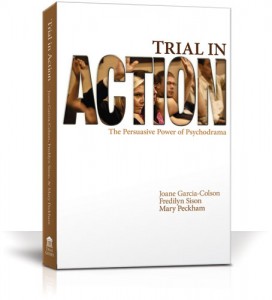
Attorneys understand that a trial is as much an art form as it is a test of facts. Psychodrama can help you better understand your clients, their backgrounds, and what shaped them before they came to you. This is the message of "Trial In Action: The Persuasive Power of Psychodrama," a new book by Joane Garcia-Colson, Fredilyn Sison and Mary Peckham. 

The action method of psychodrama helps attorneys to present the compelling story of the case through a better understanding of the parties, experts, and witnesses’ motivations. It will also help attorneys prepare cases and direct them from intake to trial.

This book is a step-by-step manual that will help lawyers who are new to psychodrama learn the basic techniques, and will help more seasoned lawyers perfect their skills. The book begins with the history of psychodrama in law, then moves on to describe the specific tools and techniques that trial lawyers use. Each instructional chapter gives a "how to," followed by an example, and finishes with an exercise you can try at home. Finally, the book gives concrete examples of how you can use your newly found psychodrama tools and skills in all parts of a trial, from voir dire to closing.

Listen here for interview with Radio Interview about this book. For more, see book's web site.

Thursday, January 13, 2011

Virginia Satir and the psychodrama link

Virginia Satir, who is considered one of the most influential and innovative of family therapists, has a psychodrama link. And a Wisconsin link.

Psychology students still read her most well-known books Conjoint Family Therapy as well as Peoplemaking and The New Peoplemaking, the last published in 1988.

Virginia Satir was born  in Neillsville, Wis., in 1916, the eldest of five children, and later moved to Milwaukee. At the age of five, Satir decided that she would grow up to be "a children's detective on parents." She later explained that "I didn't quite know what I would look for, but I realized a lot went on in families that didn't meet the eye."

Now to the link with psychodrama.

Psychodramatist Barbara Seabourne developed what she called "action sociometry" in the early 1960s, giving life to people's most important relationships by having them take postures to show their connections with each  other -- or the lack of same. Satir used similar ideas as she developed family sculpting, helping families to experierence their relationships with each other, not just talk about them.

 Zerka Moreno, the widow and collaborator of Dr. J.L. Moreno, the physician who developed psychodrama, adds that, in addition,  remembers flying to Milan, Italy, in 1963 to a conference of the International Association of Group Psychotherapy.

She writes:

"Dr. Moreno had secured seats on the plane for all those going to the conference. Virginia Satir sat across the aisle from us and attended the Moreno Academy one-day session before the conference in which I worked with a married couple. As far as I am aware, she attended all other sessions, including Moreno's presentation, at the conference, in which I presented "Sociogenesis of Individuals and Groups." She did not engage with us, nor seemed to do so much with anyone else on the plane; she was rather shy and quiet.

"We published a book containing all the presentations, called "The International Handbook of Group Psychotherapy." brought out by The Philosophical Library in New York, 1966. I was assistant editor.

"Virginia Satir's presentation is entitled: "Family Therapy: An Approach to the Treatment of Mental and Emotional Disorders." p. 441-445. She speaks, among others, of family conjoint therapy. She was, I believe, just beginning, but she was good at what she was doing.

"Virginia and I met again in 1985, in Phoenix, at the first Milton Erickson Foundation on Evolution of Psychotherapy Conference."

Satir died of pancreatic cancer soon after that meeting.

Friday, January 7, 2011

Kate Hudgins speaks on innovative psychodrama and her trauma model

Kate Hudgins, the U.S. psychodramatist and psychologist who has developed an innovative model for treatment of trauma with psychodrama speaks about her most recent work at the international psychodrama conference in Portugal in October 2010, when she was keynote speaker.

Kate, who lived and worked in Wisconsin for several years, has demonstrated and taught her model in the United States and internationally, visiting some 30 countries through the years. For the past 10 years, she’s been teaching her action-oriented Therapeutic Spiral Model in universities in China. She is now back in her hometown of Charlottesville, Va., preparing for the upcoming publication of her fourth book, “Therapeutic Spiral Model on the Frontlines,” for which I’ve written a chapter with Kevin Fullin, M.D., on using the model with survivors and perpetrators of domestic violence. Her previous book, which I recommend to my trainees, is Experiential Treatment for PTSD: The Therapeutic Spiral Model.

Here’s the link to the first video, also shown below, when she talks about her model, how it can be adapted for children and moving moments with her work in China. The interview continues on this second link where she talks about hate, violence and compassion and her work with people who suffered in both sides of the conflict in Northern Ireland and with torture survivors from Bosnia.


Friday, August 27, 2010

Laughter is healing too

I have a silly part inside of me -- and I enjoy being silly when I am leading a group. I like being able to let other people know that silliness is OK -- even healthy! I make sure that people know that laughter is permitted. It is a great and tender release, just as much as crying.


A couple years ago I presented an all-day session on laughter and fun for my trainees entitled, "Are We Having Fun Yet?" When trainees arrived, I was already wearing a silly hat. (After all, wasn't it J.L. Moreno who conducted his first public psychodrama in 1921 wearing a jester's cap?)

No outline is close at hand, but our day included:

I used a box of funny hats with people taking the hats and taking the role suggested by the hats and mixing and mingling.

A basket of colorful scarves and clothes were available for dress up.
Later, we integated these actions as part of our group:

Using nonsense languages to talk between each other about a topic.

Talking in a high voice or a low voice.

Making funny faces.

Shaking the body

Playing non-competitive games like Rain. If you haven't seen Rain or ar enot familiar with this fun non-competitive game, see:


Singing silly songs including children's songs like "Old MacDonald Had A Farm."

Playing When The  Great Wind Blows. There are many variations. Here's one: have a circle of chairs, with one less chair than the number of people. One person stands in the center of the circle and says, "The wind blows on people wearing plaid shirts." Then everyone wearing plaid shirts must get up and scurry to another chair. The last person standing says, "The wind blows on people with blue eyes." And the people with blue eyes scurry...

When I trained with Zerka Moreno, we used vignettes on "A Moment of Joy" which were acted as a monodrama or autodrama or a more traditional vignette. These were always fun to do and fun to watch. Sometimes they were humorous too -- I've changed the title sometimes to "A moment of laughter."

Just recently I've been introduced to InterPlay, a model of using play, the body, movement and silliness in a group format.

For myself, I have found that I, as a presenter and trainer, really need to be warmed up to humor. Good warm-ups need to be constructed that open the way to humor and fun for the group.

And Adam Blatner's book with Allee Blatner "The Art of Play" is inspirational and idea-full.

Wednesday, July 28, 2010

Creativity article in Newsweek has big link to psychodrama (without saying so)

Did you see the article about creativity in the July 19 edition of Newsweek?

It laments the state of creativity in American schools but also gives suggestions about  how to fix the creativity crisis and upgrade that creativity to a new level for the 21st century.

The late E. Paul Torrance – the innovative professor who is mentioned prominently in the article – had met and had been influenced by psychodrama’s developer J.L. Moreno. Torrance wrote about sociodrama and its techniques and was a recognized pioneer in the field of creativity studies.

Later in the article in Newsweek, the author reports that studies show that role playing promotes creativity with children.

Adam Blatner, one of the foremost writers about psychodrama, points out that the “this frontier of our work, cultivating spontaneity and imaginativeness, continues to accrue more of a scientific foundation."

Read the full Newsweek article here, plus take an online creativity test.


Wednesday, June 16, 2010

Eating, sleeping, sneezing -- and other roles we play

The minute that we are born, we immediately take a number of roles, including eater, sleeper and sneezer.

As we grow older, we are called to play and practice many more personal and social roles, which is how we develop, grow and mature.

Here's a little "Box O' Roles" that explains psychodramatic role theory in a fun and graphic way, courtesy of my psychodramatist colleagues Nina Garcia and Dale Richard Buchanan.

Monday, June 14, 2010

Theatre for healing, as a basis for a reality show? I say yes!

Drama therapy and psychodrama are kind of "cousins" in the world of creative arts therapies.

I like this video from Blair Glaser, MA, LCAT, RDT, a healing teacher and drama therapist in New York, as she pitches her idea for a fun-filled  reality show in which she uses drama therapy with individuals, couples, companies, and with groups in need such as inner city kids and Iraq veterans.

Blair wants to show that using theater for healing can help participants feel "dramatically different" about themselves and their lives after the sessions.  In "her" show, wiewers will learn the value of play, of listening to the various voices we carry inside, of face-to-face contact in a hyper-techno world, and the importance of engaging the body in healing the mind and heart.

I voted for Blair while making a statement that she also include mention of psychodrama in her work. Vote for her too right here.

In the meanwhile, here's footage of a real drama therapy session, including sculpting and body movement, in this video:

Thursday, June 3, 2010

Worth listening: online interviews about psychodrama

Investigative reporter Jon Rappoport recently has given some very good air time to the gifts and advantages of psychodrama on his online radio show on the Progressive Radio Network.

His show with Zerka Moreno, the "mother" of psychodrama, is here. It is a rare interview with Zerka T. Moreno, who at 93 years old, is still conducting groups in the living room of her home in a retirement village in Charlottesville, Va. She tells stories about the early years of psychodrama with her late husband, Dr. J.L. Morneo, some of which I've not heard before.

Rappoport's interview with Ed Schrieber, a psychodramatist in Massachusetts and the editor of Zerka's memoirs, is here.

Monday, May 24, 2010

Playback Theatre improvises stories of our lives


Playback Theatre is a wonderful derivative of psychodrama that has now made its own fame and boasts its own method. There are groups across the United States and around the world.

The Washington Post just featured a group in Silver Spring, Md., which is active with monthly gatherings of 70 people, some of whom volunteer to tell a personal story while a group of actors improvise their story and play it back while everyone watches. Part community building and part entertainment, these presentations may be poignant or humorous, but they are always deeply human.  In February, the topic was "Variations on a Dream" in honor of Martin Luther King Jr.; later in honor of Valentine's Day, the topic was "When We Are Granted Our Heart's Desires." For more on Playback and its trainings, click here.

Friday, May 21, 2010

New book combines psychodrama and the body

As the newest research in neuroscience reframes how and why experiential psychotherapies bring significant healing to the brain and body, a new book, "The Body Alchemy of Psychodrama" by Rebecca Ridge, arrives to show how one practitoner puts these theories into practice.

As a psychologist, psychodramatist and bodyworker, Rebecca combines her knowledge and skills to show how the action method of psychodrama blends very well with the subtle hands-on practices of craniosacral therapy, positional release, reflexology and shiatsu.

Rebecca says:

"Alchemy is a wonderfully expressive term to describe the philosophical, psychological and biological processes that illuminate and transform the body mind in each of us. The body is still and may remain forever to some degree a mysterious universe, no matter how much we might be able to explain the complexities of our body and brain’s physiological intricacies. Thus Body Alchemy involves the mystery and the potential to keep evolving one’s relationship to our body mind."
Rebecca is a Midwest trainer, educator and practitioner who divides her time between Anoka, Minn., and Australia. She explains psychodrama as an embodied form of psychotherapy and includes a historical background of  somatic psychology theories. 

As more pracititoners incorporate some kind of touch in their work, she offers a valuable chapter on the ethics of touch for the group therapist, psychodramatist and psychotherapist so that they may safely apply practices of touch in therapy. Her ideas are now incorporated in my annual experientially based ethics training, "Ethics In Action."

See Rebecca's site, which includes articles and a link to order her book here.

Friday, April 2, 2010

Moreno's psychodrama and Twelve Steps have much in common

There are several remarkable parallels between the philosophies of J.L. Moreno, the physician who developed psychodrama, and the Twelve-Step self-help movement started by Bill Wilson and Dr. Bob.

There is the importance of group.

Moreno identified people as the "healing agents" of each other, as early as 1912 when he initiated groups for red-light district prostitutes in Vienna. (We might theorize that many of these women might have had addiction prolbems and possibly were survivors of sexual abuse). He later coined the phrase "group psychotherapy" during a meeting of the American Psychiatric Association.

Bill and Dr. Bob discovered the route to sobriety in the 1930s when they came together, simply to talk about their experiences while drinking and their efforts to stay sober. The two men had no therapeutic experience -- they were simply desperate alcoholics with the desperate desire to end the drinking that was destroying their lives. The program emerged from folk wisdom that they gathered as they sat and talked in their living rooms in Akron, Ohio, and learned how to stay sober.

There is the importance of spirituality  -- confirming the idea that healing is not a matter of "fixing" what is broken but embarking on a journey of personal growth and change.

Moreno considered "the godhead" an important part of his method  and often spoke of the cosmos. The balcony on the stage that he designed -- see photo -- was often used to talk to God, angels and other spiritual beings in the protagonist's life. In one of his works, he role reversed with God, creating that intimate relationship with an otherworldly entity.

Bill W. received the now-famous letter from Carl Jung, the great Swiss psychoanalyst, in which he remarked that a "spiritual" experience was a central component to recovery and sobriety.

There is relating from direct personal experience, rather than theory.

In psychodrama, Moreno instituted the "sharing" segment after every dramatic encounter, at which time group members were discouraged from analyzing or critiquing -- but rather recommended to relate their personal experiences to others and the protagonist.

Twelve-Step groups involve participants telling personal stories of experience, strength and hope. People use first names only to keep the tradition of anonymity, and there are no "experts" and no "patients," just people following a structure of growth and change as they take inventory their lives.

Someone "directs" the path but all are able to contribute.

In psychodrama, the director facilitates the action, employing auxiliaries to play roles for the protagonist to create a fullness of experience during an enactment. Everyone co-creates the experience for each other.

In Twelve-Step groups, the leaders are ordinary group members who volunteer to lead a particular meeting as service to their group and the organization. The group co-creates the experience; the steps and the traditions provide the real ongoing leadership.

Relationships teach, inform and connect

Moreno's system of sociometry measured the relationships within any given group. He developed several role play techniques including that of doubling -- having another person speak as a person's inner voice -- to expand awareness of relationship with self during a vignette.

Twelve-Step groups recommend a sponsor, one who is more advanced in the recovery process, to mentor a newcomer to the group and guide the newcomer through the 12 steps. 

Thursday, February 4, 2010

Authentic footage of psychodrama's founder J.L. Moreno

Here's real historical footage of J.L. Moreno, the developer of psychorama and sociometry, conducting a psychodrama session.This film was shot in Paris during the First International Congress of Psychodrama in 1964. Moreno directs a psychodrama with a married couple, Paul and Michelle. Michelle is an old Parisienne, and Paul an unhappy American living in France because of his marriage. Moreno uses psychodramatic techniques to lead the couple to explore their conflicts.

Psychodrama has greatly evolved since Moreno -- a brilliant but rather over-the-top kind of guy -- first started putting groups of people on stage to act out their troubles.

Now psychodrama is much more nuanced and specialized. I had the great good fortune to study with his collaborator and widow, Zerka Moreno, for many years in Highland, N.Y.; one of the most effective sessions she directed involved no "drama," just a tiny flinch-like movement from the protagonist that proved to offer a tremenous shift in the woman's perspective and problem.

Enjoy this historical treasure:

Wednesday, January 13, 2010

Psychodrama helps train law enforcement


Every day, as people in Washington, D.C., go about their lives, the FBI, CIA, Capitol Police, Secret Service and U.S. Marshals Service stage covert dramas in and around the capital where they train. Officials say the scenarios help agents and officers integrate the intellectual, physical and emotional aspects of classroom instruction. Most exercises are performed inside restricted compounds. But they also unfold in public parks, suburban golf clubs and downtown transit stations.

Psychodrama assists in the training of these officers and agents, and Barry Spodak, LICSW, TEP, discusses the schizophrenic, bipolar and paranoid characters that he created to help law enforcement agents assess threats on the lives of presidents, Supreme Court justices and other VIPS in The Washington Post article Threat Theater: For The Actors, It's A Living. For The Officers, It's A Test Of Nerve. Also available, a video.

Sunday, January 10, 2010

Rene Marineau talks about discovering the life of J.L. Moreno

Rene Marineau, the main biographer of J.L. Moreno,  talks about his experiences in documenting the life of the developer of psychodrama, and his first meeting with him in 1971 in this video.

"We learned with our feet, rather than our brain," he says of this seminal action method although he confesses that he was not impressed with the "doctor" upon his first meeting. Gradually, he followed the threads of interest to find the truth of Moreno's life, as well as Moreno's gifts of imagination and symbolism.

Marineau, a professor, psychologist and psychoanalyst from Quebec, Canada, is a former president of the American Society of Group Psychotherapy and Psychodrama. More about his book here, plus an excerpt here.

Thursday, January 7, 2010

New books combine psychodrama, art, somatic therapies

Two psychodramatists have published books on combining psychodrama with their specialties.

Rebecca Ridge has published a new book on the integration of psychodrama and somatic therapies entitled, The Body Alchemy of Psychodrama." Ridge, a psychodramatist and body therapist, divides her time between Drummoyne, Australia, and Anoka, Minn., and teaches craniosacral therapy and various body therapies for the Upledger Institute. Her book discusses how she has integrated psychodrama, somatic therapies and Chinese medicine. Find more information here.

Satya Winkelman. psychodramatist and artist in Sarasota, Fla., has  written "Through The Fire -- A Woman's Guide To Transformation" which takes the reader on a journey of the feminine cycles of change and provides activities for personal growth.  She been a communication trainer and consultant for Fortune 500 companies, schools, churches and businesses in the United States and internationally for more than 25 years. Read an excerpt here.

Monday, January 4, 2010

New Year's invitation to self care

Today's post is a guest blog from Connie Lawrence, a licensed clinical social worker and certified experiential therapist in Cleveland, Ohio, who uses psychodrama and other experiential activities in her practice.

This is an invitation to join me in a playful exercise in forming a whole new relationship with self care. Rather than the grim New year's crackdown of "I'm going to stop (eating, drinking, smoking, etc.)", how about an uplifting approach? How about indulging in an unlimted supply of whatever your soul really craves?

Here is the question:

"If I could have an unlimited supply of something in 2010, what would it be?"

Two years ago my answer was MUSIC. That year I bought my iPod and discovered a deep-sea underworld of rhythm, culture, healing and ideas springing forth of what people can do with the right music. I began germinating the concept of "Rock the House!" to build connection and spontaneity through music, which has led me to people around the country and inspiring activities. It opened up a whole new world of creativity.

Last year my soul's answer was SERENITY. I can have as much serenity as I want, whenever I want. I can stand up for it, protect it, and I deserve it. It led me to a new frontier of boundary-setting I didn't know was available.

Here's how I do this:

Once the answer bubbles up from my soul, I find a way to concretize it. Last year SERENITY was small box with a clear blue stone on it. It can be anything -- a drawing, a stone, a box, an art project, a simple note. Then I have some dialogue with it.

What would I like to ask Serenity?
What would Serenity say back?

Just as I sat down the write this message, I opened the Serenity box and found this note, "You can have as much as you want in 2009. Close your eyes, breathe, and I will be here. You deserve it. You've already set the boundaries -- and you can set more. Dive in."

So this is my invitation: let's indulge ourselves in good care. It's soul food that doesn't go to your hips. Please join me in the adventure.

Friday, October 16, 2009

Social media is really about networking, and networking is about sociometry

I just discovered David Armano who is tuned in to the connections that people make. He says -- and I agree -- that it's not about Twitter or Facebook or whatever. It's about people. Take a look at his slide show, below, and notice how many diagrams are related to the social atom, a basic unit in the study of sociometry and shows the value of visual thinking.

Thursday, October 15, 2009

Zerka Moreno demonstrates the power of role reversal

Zerka Moreno masterfully conducts an actual psychodrama session with a group of experienced psychodrama practitioners. The protagonist "Frank" has been having great difficulty completing his doctoral thesis on psychodrama. Zerka directs him in several powerful scenes, including role reversals with his unfinished thesis as well as with his grandfather.

Frank’s head is full of what he knows – but “being” the other allows for powerful shifts within the person that is not possible just by thinking about it and talking about it.

Zerka collaborated in the development of psychodrama with her late husband, Dr. J.L. Moreno. I had the great privilege to study with her at Boughton Place in Highland, N.Y., and it was she who encouraged me to become a board-certified trainer. Now in her 90s, Zerka still conducts sessions in the living room of her home in Charlottesville, Va. Listen to what she has to say about creativity:


Wednesday, October 7, 2009

Getting ready for the psychodrama exam? Some tips.

In the psychodrama world, the tests for Certified Practitioner and Trainer, Educator and Practitioner are coming up this month.

As a supervisor and volunteer reader for the exam, which is conducted by the American Board of Examiners for Psychodrama, Sociometry and Group Psychotherapy, I’ve compiled several suggestions that have been helpful for me and others.

I plan to add these tips to my next revision of The Psychodrama Notebook, but I want to offer them now for those candidates who are in high-prep mode after years of training. These suggestions can be adapted for other exams in school and for professional tests, too.

Get the American Psychological Association's code of conduct online and become familiar with the basics of the code.

Review sociometry by visiting Anne Hale’s great Web site International Sociometry Training Network, where you will find great discussion and answers.

Read each question carefully and make sure you fully understand the question. Make a few side notes to focus on the basic points you wish to cover in your essay.

Focus on answering the question, and all parts of the question, completely and accurately. If the question asks you to discuss three points of “x,” make sure that you cover three points, not two points, or one point on “x.”

In addition to the information that you present, identify how you might apply the information to a real-life practitioner or trainer situation in your psychodrama group or with a client.

Answer from your role. If you are taking the test to become practitioner, identify the points regarding to practice with clients; if you are taking the test to become a trainer, identify how you would train your students regarding the issue.

Practice exquisite self care – get yourself into the schedule of getting enough sleep and rest, eating properly and such in the weeks and days before the exam.

On the day of the exam, make sure you eat a healthy breakfast with high-quality protein. High-quality protein might include hard-cooked eggs, peanut butter, other nuts and seeds, yogurt, low-fat cheese and the like. Avoid foods that are heavy or sugary which might affect your mood or ability to think.

Bring a snack which should also include high-quality protein to the test.

Make sure you drink enough water. Dehydration will slow your brain and contribute to sluggish thinking. Think about it – plants wilt when they don’t have enough water.

Supplements that may be helpful are Vitamin B-12 and Omega-3 fish oil, which you can start taking now in preparation for the exam. Vitamin B is important for stress and Omega-3 feeds the brain. I also recommend Green Matcha Tea, a green tea from Japan, which offers four hours of ability to focus and easy concentration.

Remember to breathe.

Good luck!

Sunday, April 26, 2009

Creativity is in high demand in these low economic times


Who wants to be a millionaire?

Difficult economic times have spawned zillions of new ideas, entrepreneurship and even millionaires. There are multiple stories on the Web claiming that that more millionaires were made during the era of the Great Depression than in any other era in U.S. history. Whether that story is true, I don’t know – but I do believe that many people saw opportunities amid inflation, unemployment and soup lines and found themselves thriving rather than just surviving.

There are people, me included, who say that the current recession is no exception the possibility of innovation and prosperity. I like how Andrew Razeghi, author of “The Riddle: Where Ideas Come From And How To Have Better Ones,” says that economic downturns are good times to break with the status quo. The fact is that creativity is a key skill in this economic market. Business people, large and small, must approach their businesses, employees, marketing strategies, products and services with new eyes and the willingness to make appropriate changes. People who are creative – who have the gifts of looking at timeworn cultural traditions and finding new possibilities -- are in great demand.

But what is creativity?
We have to banish the idea that: “Creativity is thinking outside of the box.” It is NOT! Creativity is using BOTH sides of the brain — the right brain and the left brain — and the ability of the brain cooperate and to put information together in new ways. We create best when we balance the brain and use both our thinking and feeling capacities. Here’s a quote from Rosabeth Moss Kanter that I love:

“Creativity is a lot like looking at the world through a kaleidoscope. You look at a set of elements, the same ones everyone else sees, but then reassemble those floating bits and pieces into an enticing new possibility. Effective leaders are able to.”
Or, as I like to say:
"Forget the box! It doesn’t work that way! Forget the emphasis on thinking. It doesn’t work that way. It’s the BRAIN, not the box."

Jill Bolte Taylor’s amazing new book, “My Stroke Of Insight: A Brain Scientist's Personal Journey,” eloquently tells about her stroke and how she could no longer think in a linear fashion. She experienced the different parts of her brain, gained in capacity to stay in the present moment, developed new skills and learned that the right brain is the key to enlightenment. See information about the book. read an interview and watch a video here and visit her own Web site here. She says:

"...although I lost my left cognitive mind that thinks in language, I retained my right hemisphere that thinks in pictures."
I am always available for creativity coaching by personal appointment and phone. With the magic of psychodrama theory and techniques -- which impact both the cognitive and imaginative sides of the brain -- we can delve deep to find your gifts, identify and refine new ideas and decide how to present them for public consumption. Right now I’m working on a free e-book about how creativity works. Let me know if you’d like to be on my mailing list to receive a copy.

Thursday, April 23, 2009

Next year, psychodrama in Philadelphia!

The 2010 psychodrama conference is scheduled for Philadelphia, Pa., from April 15-19. See American Society of Group Psychotherapy and Psychodrama for more details, including the date for request for conference presentation proposals.

The 2009 conference in St. Louis, Mo., was wonderful. It was very good to connect with colleagues – some for a meal and a good talk and even just for a moment for a good hug – as well as meet new contacts and make new friends. It was great to see three of my trainees present, including one trainee new to psychodrama who was enjoying every inspiring and energetic minute!

As a psychodramatist now smitten with Systemic Constellation Work, I was pleased to note that was such an interest in that workshop that I presented with Ron Anderson – and also notice that more and more psychodramatists are pioneering and integrating some kind of energy work with their presentations and specialties – including Kate Cook, John Olesen, Jack Shupe, Georgia Rigg, Susan Aaron and of course, Donna Little who saw its possibilities long before me.

We were pleased with the feedback from our Constellation workshop:

“Practical application demonstrated -- all questions answered with competence and respect.”

“The strengths of the workshop was the power of the work and Ron and Karen’s obvious resonance with the work.

“Well done hands-on demonstration of unfamiliar material.”

“Excellent and generous handout.”


Tuesday, April 14, 2009

Bring health to your conference

It's well known that there is a growing surge of interest in alternative health, not only in private life but also in the business world. Activities such as yoga, tai chi, meditation and play are making inroads into the most conservative of businesses as more people realize that these activities pay dividends in energizing employees, reducing stress and maintaining health.

Adding healthy activities to your business meeting, conference or reunion will pay similar benefits.

There are lots of reasons to include these activities in your meeting. Attendees who are arriving weary and disoriented with jet lag, for instance, will appreciate activities that provide a little nurturing and the opportunity to truly "arrive," not only in body but in spirit.

Activities such as yoga, keep people awake and engaged. The breathing and stretching that is part of many styles of yoga provide energy and improve concentration and focus. Tai chi, the Asian art of moving meditation, provides similar benefits. Chair massage will help loosen muscles that have been crunched into a tight plane seat with little leg room. And modalities such as craniosacral therapy, which involves a very gentle manipulation of the head and neck, gives a refreshing and rejuvenating experience.

Other activities that are suitable for meetings include meditation, dance, walking or hiking, drumming and music-making, Feldenkrais, and chi gong, Reiki and other energy work.

There is the added value -- another reason to make your meeting special and memorable, which is always the goal of meeting planners, Whether in the morning, after a large lunch or several hours of sitting, these healthy activities will reenergize you more easily than a gallon of coffee or a sugary soda -- and more healthful, too. In the evening, they will support you to calm and relax in such a way that you'll forget that you are sleeping in an unfamiliar place.

Finally, many attendees will enjoy the opportunity to get acquainted with others in less formal settings.

Taylor Rockwell, a psychodramatist and psychologist from Freeport, Ill., facilitates drumming circles for reunions, weddings and other gatherings. These drumming activities quickly build a community spirit while dissolving feelings of stress and disconnection.

The American Society of Group Psychotherapy and Psychodrama, my professional organization, has offered Zumba, Nia, yoga and other fun wake-up or cool-down activities thorough the years. At numerous conferences and gatherings, I’ve offered simple meditations, guided imageries, stretching and mirroring movement exercises which can be easily learned when you’re not a specialist in one of the fields.

If you're organizing, here are some tips to remember:

Check to learn if your conference venue has staff members or contractors who are available to facilitate or offer these activities.


If your conference venue does not offer such services, you will need to find your own. Ask for instructors who are experienced, educated and knowledgeable in their fields who are able to communicate their specialties easily. Chances are that your attendees will come from a variety of backgrounds, including ages, ability and level of knowledge. Your instructor should be able to professionally deal with these various types of people and be able to respond knowledgeably to various needs or concerns.

Offer a variety of activities. Not everyone enjoys the same activities or has the same level of physical ability; others may prefer to experiment with a new activity away from home.

In your registration literature, alert attendees to the opportunities that will be available at your meeting and inform them about any particular clothing or equipment they will need to bring to the conference. Usually comfortable and loose clothing is best, but sometimes sneakers or other warm weather clothing are required if you plan a nature activity such as hiking in the woods, for instance.

Work closely with the instructor or facilitator to learn what kinds of space will be most suitable for each activity. Check for areas that will offer adequate room to move comfortably if you are offering a class such as tai chi, yoga or dance. Other activities, such as chair massage, may benefit from spaces that are quiet and relaxing. Some attendees, particularly those who are a bit shy about trying these activities for the first time, may also enjoy some level of privacy from the bustling crowd. If you are offering more than one activity at the same time, be sure that they complement each other in terms of sound or schedule each one at a different location; for instance, you won't want to schedule a loud drumming circle next door to an hour of meditation.

Determine if you will have to supply any equipment -- such as a sound system or CD player, yoga mats or massage chair -- or if the instructor will provide his or her materials or equipment.

Have a back-up plan. Doing tai chi at sunrise at on the shores of Lake Michigan may sound like a wonderful idea, but it won't be so wonderful if it's raining like cats and dogs between strikes of thunder and brain-rattling bolts of lightning. Be sure to have alternate plans to account for inclement weather, insect infestations and other uncomfortable situations.

Monday, March 23, 2009

Inspired and enchanted by Bert Hellinger's Systemic Constellation Work


I’ve just returned from a training on Systemic Constellation Work and I’m truly inspired – not only by the method but the opportunity to meet several helping professionals offering leading-edge healing and change.

Systemic Constellation Work – sometimes called Systemic Family Constellation Work – is a trans-generational healing process developed by Bert Hellinger, a German psychotherapist and former missionary in photo above, about 20-plus years ago and has been spreading rapidly throughout Europe and is gradually coming to the United States.

I am completely enchanted with this approach, which I have been studying and reading about for more than two years – more in depth recently – and I have begun to integrate its principles into my work with psychodrama and the creative arts therapies.

It has a spiritual approach – with lots of talk about the “soul” of a family; Hellinger calls this the “greater force.” Basically, Systemic Constellation Work says that we are connected to our ancestors by an invisible energetic network and that we may carry their pain and difficulties as a way of staying energetically connected to the larger family soul. When we are able to address and heal these energetic entanglements, the ancestors are able to rest peacefully and we stay connected to our family members in more appropriate ways. And, our own lives change gradually for the better.

The training center where I study is the Hellinger Center of D.C., and the trainer is Heinz Stark, who is from Bremen, Germany, and one of Hellinger’s early protégées. You can go to Hellinger Center of D.C. and find several links to Hellinger, Stark and other important trainers as well as papers and lectures by many facilitators. I will warn you that a number of the principles is NOT related to the traditional mental health model – sometimes quite startling in its differences – but I can vouch for Constellation Work as an amazing method which has already made a difference in my life.

Constellation Work is an action method like psychodrama and is very similar in some ways -- yet very different. While it is rooted in the psychotherapeutic tradition, the method is distinguished from conventional psychotherapy in that the client hardly speaks and aim is to identify and release deep patterns embedded within the family system rather than to explore or process narrative, cognitive or emotional content.

Here’s a link from a lecture from Bert Hellinger on peace of mind, soul and love; there are many more lectures at his Web site.

And there's more. Science is now offering studies that back up this approach of the contention that experiences are inherited. Here is the link to the BBC documentary, “The Ghost In Your Genes,” that actually offers fascinating proof about inheritance beyond hair and eye color and height. There very short version of this video on You Tube but does not go into the good details. The BCC version is 48 minutes, so you'll want to link to it when you have some time. I think it’s excellently done and is completely fascinating.

You can find several examples of actual Constellation sessions on YouTube – just go to to the site and search for “Systemic Family Constellation Work.” Most of them are in another language but you can get the idea of how it looks. I'll be co-presenting with my colleague Ron Anderson on "Couples Work With Systemic Constellation Work" at the annual conference of the American Society of Group Psychotherapy and Psychodrama later this week in St. Louis, Mo. Watch for our handouts to be posted at another time.

Monday, March 2, 2009

Facebook, networking and psychodrama

Networking refers to the connections that you have to people in your professional and personal worlds. The larger your network, then the more opportunities that you will have to share your work and beliefs, talk about your businesses and practices and find referrals, resources, information and encouragement. (Actually, this is what Facebook is all about!)

In the world of psychodrama, there is a related field known as sociometry, which refers to the measurement of social connections in any given group. Knowledge of sociometric measurement and the ability to apply sociometric skills to expand your network will ease those times when you enter events such as mixers, open houses, club meetings, awards events and community functions where we know very few or no people.

Although these getting-to-know-you events are good ways of meeting new people and enlarging our circles of friends and colleagues, they also test our abilities to be creative and relaxed in situations where we may experience pressure, confusion or shyness. Many professionals work on carefully crafting a two-minute "elevator speech" — the mini-introduction that explains what they do in the time it takes an elevator to travel a few floors. Others avoid large crowds and prefer to do their networking one at a time over lunch, breakfast or a cup of coffee.

However, to make best use of special events, here are a few simple suggestions that are helpful and fit a large variety of situations:

Notice who you are drawn to. These connections are "telic" connections, relating to the "tele" that Dr. J.L. Moreno named as an invisible level of energy between people. Trust your instincts regarding what people you notice and who seems to catch your eye in the crowd. The way someone dresses, his or her level of energy, even the expression on his or her face may draw you to learn more about that person. You may not know why you are drawn to this person, but make time to learn what is attracting your attention.

Develop the role of the "interviewer." Identify a range of questions that are related to your business or occupation. Perhaps you are experiencing a small problem in your work; the networking event is an ideal time to seek out solutions or resources. Are you looking for a new long distance phone company? Trying to decide where to advertise? Or seeking good accountant, graphic designer or coach? Begin your question with, "Do you know someone who…" and this may help you meet more people — in addition to getting actual help in solving your problem.

Be creative and spontaneous. If you have the opportunity to introduce yourself to a lot or people, practice varying your "spiel" with each person so that you don't say the same thing twice. Your words will stay fresh, you will feel more energy and you may find new connections and topics to talk about — even among people whom you have met before. It is a good alternative to going on "remote control," which you will forget to listen to yourself.

Play the role of listener. Our energy ebbs and flows, and it's all right to take a break from talking to just listen, breathe and pause. If you notice a twosome or cluster of people talking with animation, stroll over to check out what's so interesting. Listen and ponder. You may be surprised to know what you can learn by listening.

Expand your repertoire of roles. You can also easily meet people by volunteering to fill a particular role or task for an organization or club where you are a member. The task — such as greeter, survey taker or chairperson of a committee —will give you specific reasons to meet new people while you are also making yourself valuable to the organization.

Oh, yes, Facebook. Facebook, like LinkedIn and the new Social Networking for Therapists, offers the opportunity to adapt these skills and build networks online. See this link for a group of psychodramatists and sociometrists who have joined Facebook and are creating a growing Global Sociometric Encounter.

This article is adapted from Karen's "Whole Person Marketing" e-book which offers friendly ideas on creative marketing for holistic professionals, including tips for brochures, press releases, contact with various media, mailing lists, Internet visibility, community presentations, health fairs, conferences, handouts, plus marketing and advertising resources. 90+ pages. Available in PDF format on CD for sale price of $15, with $5 extra for postage and handling. See Lake House Health & Learning Center to order and use this sale code: Blog0302.

Friday, February 27, 2009

The Living Newspaper, 21st century

One of the early sociodramatic structures created by Dr. J.L. Moreno, the physician who developed the action method of psychodrama, was what he called "The Living Newspaper." Participants in Dr. Moreno's groups in Vienna, Austria, would peruse a copy of the day's newspaper, select articles that were of interest and then improvise the scenes of the story, as biographer Rene Marineau tells here. Later, Dr. Moreno enacted significant events with larger groups at professional conferences, including such issues as the 1948 race riots in Harlem, the trial of Adolf Eichmann in Jerusalem in 1961 and the assassination of John F. Kennedy in Dallas in 1963.

Now two news-loving entrepreneurs have created gaming platforms that focus on role-playing discussions with world leaders about significant issues and other interactive news events. Using audio, video and interactivity, Eric Brown and Asi Burak have created more than 100 games on "Play the News." The games are designed to help people understand complex topics that range from the U.S. election, auto mergers, big oil in Iraq and the Israeli-Palestinian conflict. The Poynter Institute reports here.

The facts of change, one stage at a time


How are you changing today?

Change is more than a buzzword, more than a political slogan – it’s a fact of life. Today’s training workshop took a look at the six stages of change as identified by psychologist James Prochaska, author of “Changing For Good” with John C. Norcorss and Carol DiClemente.

First, we borrowed Natalie Miller’s “Walking The Wheel Of Change” action structure that she used when presenting at the annual conference of the American Society of Group Psychotherapy and Psychodrama in 2006. Then, using the psychodramatic techniques of concretization, locograms and spectograms and the role-play techniques of role reversal and doubling, we explored at how these six stages can be enlivened with props -- notice the beautiful butterfly above -- metaphors and dramatic vignettes. As we proceeded, we covered examples of personal growth, psychotherapy, coaching, staff training and clinical supervision.

Some responses from today's trainees:

"I learned group activities that can be used with staff and clients."
"It was a good learning experience."
"Was helpful to have a local or near location."
"Found a sense of acceptance and patience ...."
"Short presentations are wonderful -- I like Fridays."

If you're not familiar with Prochaska’s model – developed after studying how 1,000 people significantly changed their lives in some way – here’s a quick overview:

Pre-contemplation – In this stage, people not only can’t see the solution, they can’t even see the problem. They don’t believe they have a problem so they don’t need to change. But people around them can see problems developing.

Contemplation – Here, people start to think that they have a problem. They try to understand it and learn its causes, and they wonder about how to solve it. They believe that some day they will need to change, but they think this day is sometime in the future.

Preparation – Most people in this stage are planning to take action within a month. They’re going to save money, eat less junk food, stop smoking, reduce their drinking or somehow change their lives. The point here is that they’re making plans. They may question their motives and trying to convince themselves that they need to take action soon.

Action – At this stage, people stop the unhealthy behavior or begin the behavior they want to follow. They pour out the rest of that bottle of vodka. They break or tear up their drug paraphernalia and throw it in the trash. They decide they’re not going to hang with the same old crowd. They stop going to the same old places. They start planning their meals, cleaning out the clutter or putting a part of their paycheck into a savings account.

Maintenance – At this stage, people work on maintaining new habits. They find ways to prevent lapses and relapses. They learn how to deal with cravings and how to deal with their emotions without resorting to substances or junk food. They keep the closet clean or exercise according to schedule. Often they need to rebuild family relationships and develop new friendships.

Recycling – Change is circular and sometimes people aren't able to keep their change pattern. Although your new pattern is the ultimate goal, if you have a relapse (the doughnuts your coworker brings to work, perhaps) remember that it's not an "all or nothing" proposition: you have not failed, you had one misstep; keep working at it.

Wednesday, February 25, 2009

Sex addiction and psychodrama

Sex addiction and psychodrama.

Yesterday’s request of Racine’s former mayor to attend treatment center for compulsive sexual behavior and trauma are bringing his legal charges – and discussions about sex addiction – back into the public eye.

Questions about what is effective treatment are coming forward, as well as what effective treatment involves. Many good programs are available for in-depth treatment of sex addiction and compulsivity, and a number of programs include psychodrama as an important component of their treatment structure. If you’ve been reading this blog, you know that psychodrama is a powerful action method that can bring deeper insights to an emotional difficult issue. Because addicts typically use compulsive behaviors to avoid the experience of self, experiential therapy offers opportunities to have direct experience of self, behaviors and feelings in a structured setting. It has the potential to quickly address issues, feelings and patterns that have been hidden and would take months, or even years, to discover in conventional talk therapy. Experiential treatment allows the addict to actually experience the unmanageability of their lives, the possibility of change and the promise of recovery.

Psychodrama is compatible with the 12-Step ideals that are the core of many treatment programs. J.L. Moreno, the physician who developed psychodrama, understood the healing value of the group as early as 1913 — long before 12-Step groups got their start — and coined the phrase “group psychotherapy.” Several skilled clinicians facilitate psychodrama in a number of well-known treatment centers, including:

Robert Fuhlrodt, LCSW, TEP, at Montclair STAR in Montclair, N.J.
Arlene Story, LPC, CADC III, TEP, at The Refuge-A Healing Place in Ocklawaha, Fla.
Nancy Roberts Willis, LCSW, CP, at Keystone Center Extended Care Unit, Chester, Pa.

Tian Dayton, my friend and colleague, offers background and ideas for using psychodramatic and sociometric techniques with addiction in online article here.

For information, see my online booklet, "Addiction, Action and Change: Experiential Methods Make The Big Difference In Treatment," which includes an essay on psychodrama and addiction treatment.

Monday, February 23, 2009

Annual conference coming right up

The 67th annual gathering of the American Society of Group Psychotherapy and Psychodrama is getting ready to roll.

The professional association's 2009 conference takes place in the Midwest, this year in the gateway city of St. Louis, Mo., from March 26-30. I'm proud to be co-presenting with my colleague Ron Anderson, LPC, CADC III, TEP, on the topic, "Couples Work With Systemic Family Constellation Work." See the online catalog here. There's still time to register, too.

Monday, February 16, 2009

Why warm-ups for groups are so important

Any group that gathers will move ahead in certain predictable stages.

The more that the group facilitator knows about these stages, the moreher or she will be able to facilitate a group with genuine involvement, depth and disclosure. The best group leaders follow a directed but flexible three-part process:

· A warm-up
· High involvement
· Wrap-up

The proper warm-up allows the group to create readiness for the core of the meeting, whether it is designed for education, planning or another task. The core of the meeting is the high involvement, which may take several forms depending on the task and reason for the gathering — Learning? Brainstorming? Healing? Facilitating an exploration of the participants' deepest thoughts and needs? Making plans or organizing the next step? Or something else?

Finally, the wrap-up bring closure to the meeting itself, even if more work is planned later or other needs must be addressed.

Many facilitators know the value of warm ups — sometimes popularly called "ice breakers" — but often don't know how to select the proper activity for a group. Manuals and books have lots of ideas, but veteran facilitators know from experience that what looks great on paper may not work so well in reality.

In preparing the warm-up segment, each group facilitator must always ask: what do I want to warm the group up to?